



Lead: University of Technology Sydney



Research
Big Ideas, Real Impact.
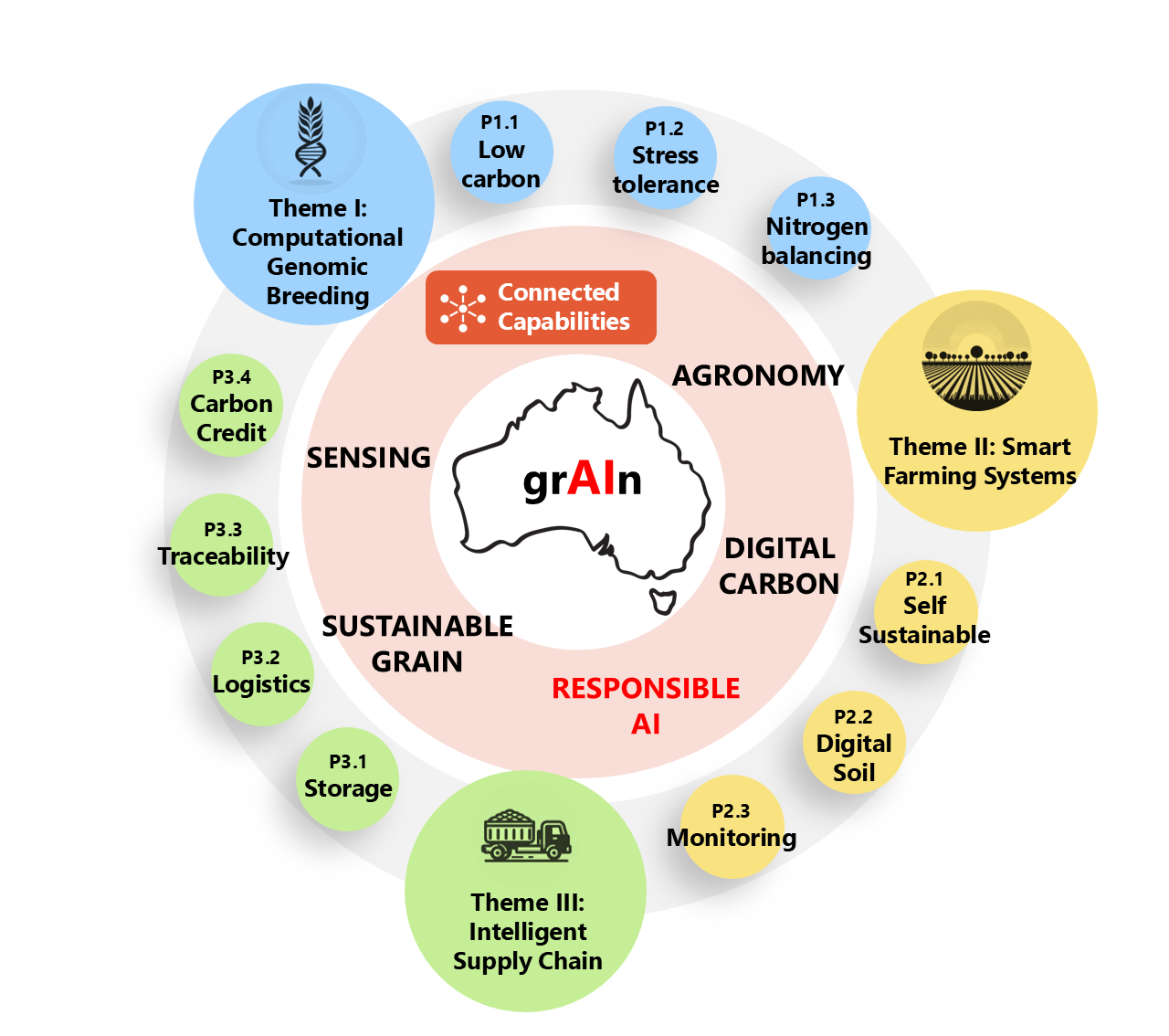
The conceptual framework of the gRAIn Hub, integrates five connected capabilities: Responsible AI, Sustainable Grain, Sensing, Agronomy, Digital Carbon. Combined, these spheres of expertise will resolve the challenges of transforming Australia’s grain industry into a sustainable AI-driven sector. Importantly, these capabilities address issues across the entire cultivation cycle, from breeding to farming to the supply chain. Across each theme, the existing barriers to adopting AI will be identified first. Then, RAI-based methods will be developed to resolve these barriers and produce outputs that directly support the goals of this Hub.
Research Themes

-
This theme will focus on advancing grain breeding research through three core projects:
P1.1 – identifying the optimal traits for photosynthesis;
P1.2 – early prediction of environmental stress tolerances;
P1.3 optimising the balance between nitrogen use and fixation.By integrating genomic breeding with cutting-edge RAI methods for predictive analysis and optimisation, this theme aims to develop innovative approaches to reduce CE, improve carbon fixation (CF) and enhance climate adaptability. In terms of RAI, a key emphasis is placed on explainable AI as a way of providing transparent justifications for the AI’s predictions and optimisation decisions.
-
This theme centres on the comprehensive monitoring and autonomous management of farming operations through three core projects:
P2.1 – developing a self-sustainable grain production system;
P2.2 – advancing soil digitisation;
P2.3 – creating a smart farm monitoring system.
To overcome the challenges of unreliable AI results in the real world, where data can be noisy and limited, this theme will prioritise RAI in terms of robust AI techniques. The theme aims to improve the accuracy and resilience of AI-driven solutions in smart farming with reliable decision-making tools and system controls that work across a diverse range of agricultural environments. -
This theme targets the grain distribution stage, aiming to deliver sustainable, high-efficiency supply chain solutions through four core projects:
P3.1 targets storage with ways to prevent deterioration.
P3.2 concerns optimising logistics.
P3.3 involves a grain traceability exercise.
P3.4 entails developing a system to track digital carbon credits (CC).
To address privacy issues, this theme emphasises innovations in privacy-preserving AI to ensure that proprietary and sensitive information remains secure during supply chain optimisation. Incorporating these RAI, the hub will support a transparent, resilient, and sustainable grain supply chain.
Pilot Studies
Title: Responsible AI for disease detection and severity assessment from multimodal imagery of grain seeds
Chief Investigators: Prof. Ferdous Sohel, Prof. Chengdao Li, aand Dr Penghao Wang
Description: Provide a concise overview of the pilot project, including:
Problem: The detection of plant diseases is a challenging task due to the wide variety of diseases that can affect the grains, varying due to their variety, weather, regions, seasons, and other physiological factors. Additionally, the subtle visual differences between healthy and diseased seeds require advanced techniques capable of precise identification and classification. We aim to propose deep learning models for disease detection and severity assessment.
Purpose: to achieve high throughout phenotyping of disease varieties and their severity.
Methods: Advanced, robust, and interpretable AI models will be developed that can learn from small, multimodal, and not-so-ideal training datasets.
Outcomes: The developed AI models will be able to classify the seeds (so the purity of seed grain samples), detect diseases, and estimate their severity. The relevant data will serve as a benchmark for future research.
Publication: https://researchportal.murdoch.edu.au/esploro/project/research/ARC-gRAIn-Hub----Plant-Disease/9726933800007891?institution=61MUN_INST
Title: Multimodal Deep Learning for Barley Genotype-to-Phenotype Prediction Using Genomic, Environmental, and Phenotypic Data
Chief Investigator(s): A/Prof. Guanjin Wang, Dr. Junyu Xuan, Dr Penghao Wang, Prof. Chengdao Li, and Prof.Jie Lu
Description: This pilot study addresses the challenge of accurately predicting complex crop phenotypes from high-dimensional and heterogeneous agricultural data. Its purpose is to improve barley flowering time and grain yield prediction by integrating genomic, environmental, and study-condition data using advanced deep learning methods. The study employs multimodal deep learning architectures, including CNNs for genomic markers and LSTM-based models for environmental time-series data, trained in an end-to-end manner. Experiments were conducted on real-world barley datasets from Western Australia. The outcomes demonstrate improved predictive accuracy and robustness compared to unimodal and traditional fusion approaches, highlighting the potential of multimodal AI to support data-driven crop improvement and sustainable agriculture.
Publications:
Wang, G., Xuan, J., Wang, P., Li, C. and Lu, J., 2024, November. Lstm autoencoder-based deep neural networks for barley genotype-to-phenotype prediction. In Australasian Joint Conference on Artificial Intelligence (pp. 342-353). Singapore: Springer Nature Singapore.
Pradhan, S., Wang, G., Xuan, J., Wang, P., Li, C. and Lu, J., 2025, May. A multimodal deep learning end-to-end model for improving barley genotype-to-phenotype prediction using heterogeneous data. In 2025 IEEE Conference on Artificial Intelligence (CAI) (pp. 322-327). IEEE.